
Big IT Project
Silver Valley, Shoshone County, Idaho, USA

Silver Valley, Shoshone County, Idaho, USA
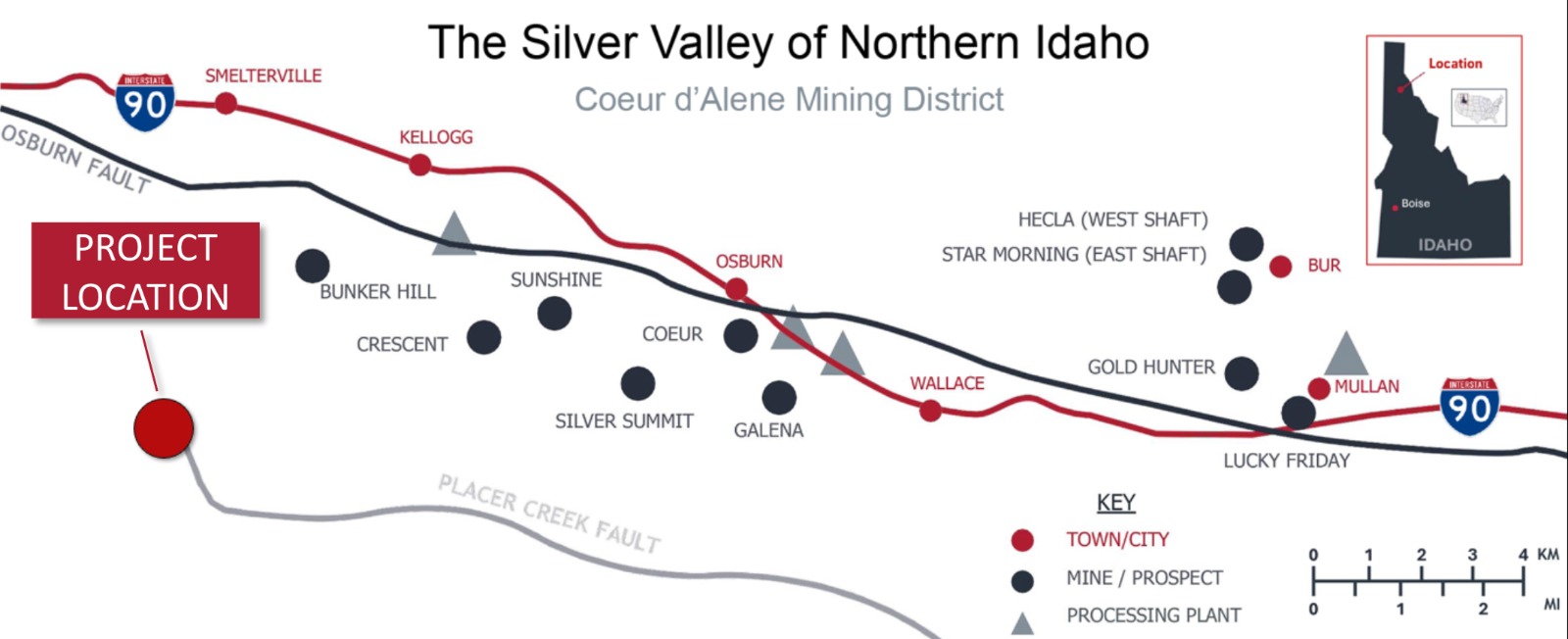
Developed during the 1950’s under United States Bureau of Mines (USBM) and Defence Minerals Exploration Administration (DMEA) programmes, Big It supplied high-grade tungsten concentrates to support strategic stockpiling initiatives. Historical records confirm production of premium-grade scheelite concentrates grading between 67–75% WO₃, with available historical underground sampling returning individual values of up to 2,980 ppm W, 19.5% Sb, and 11.15 g/t Au highlighting the project’s significance as a former supplier of critical minerals.
The project comprises three unpatented federal mining claims and approximately 101 acres of freehold land, with approximately 380 metres of underground development. Located approximately 11 kilometres from the planned Sunshine Mine antimony processing facility, Big It occupies a strategic position within a district benefiting from established infrastructure, mining expertise and strong exploration potential.
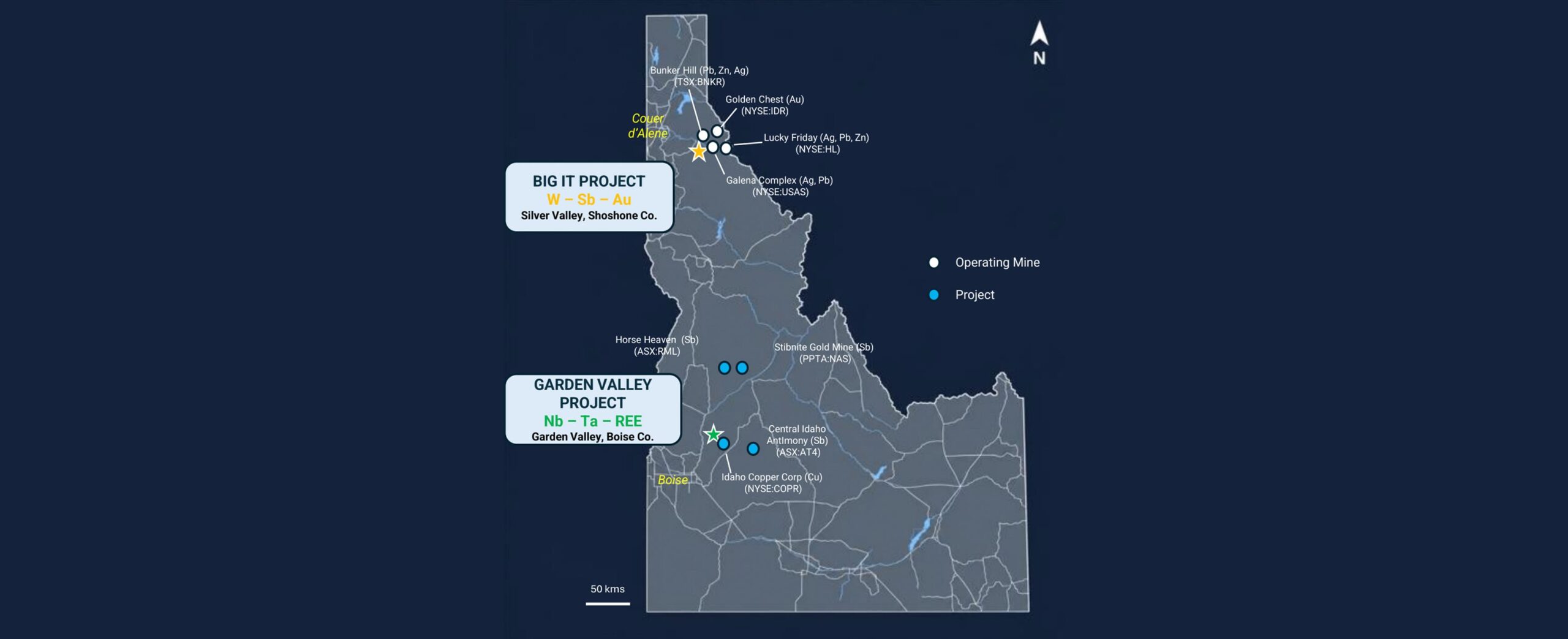
Location: Silver Valley, Shoshone County, Idaho, USA
The Columbite Project provides exposure to several minerals identified as strategically important for technology, defence and energy transition industries.
Key commodities include Niobium (Nb), Tantalum (Ta), Rare Earth Elements (REEs) and Fluorspar (CaF₂).
The United States currently has no domestic production of niobium or tantalum and remains heavily dependent on imported supply, while fluorspar is also classified as a critical mineral due to its importance in industrial and battery supply chains.

2013 #3 Sample
Historic Lens 1 — scheelite-quartz
B-50 — vein
Confirmed wartime shipments to U.S. Government
The Big It Project is centred on an historically developed tungsten-antimony-gold mineralised vein system hosted within the Pritchard Formation of the Precambrian Belt Supergroup in the Pine Creek area of northern Idaho.
The region benefits from established road, power and telecommunications infrastructure, a skilled and experienced mining workforce, a long history of mining and permitting activity, and proximity to multiple historic tungsten and antimony occurrences.
A key strategic advantage is the project's location near the planned Sunshine Mine antimony processing facility, which is expected to become the only operating antimony processing plant in the United States, subject to future agreements and processing capacity.
The Pritchard Formation at Big It is comprised predominantly of interbedded black slate and finely banded, dark fine-grained quartzite, with distinctive white quartzite horizons.
Historical mineralogical descriptions identify scheelite, stibnite, sphalerite, pyrite, siderite and ankerite within a quartz vein, with arsenopyrite reported in the immediately adjacent wall rocks and chloritic alteration developed parallel to the vein. Gold was also historically reported within the mineralised system.
The underground workings provide direct evidence that mineralisation extends over a meaningful strike extent. Importantly, historical U.S. Government investigators also identified the potential for additional scheelite-bearing quartz veins away from the developed structure.
Historical sampling and production records report:
Antimony grades up to 39.7% Sb
Tungsten grades up to 12.9% WO₃
Gold grades up to 11.2 g/t Au
Tungsten concentrate grades of 67–75% WO₃
These grades demonstrate the project's potential as a multi-commodity critical minerals opportunity with exposure to tungsten, antimony and gold.
Historical underground sampling undertaken in 2016 returned locally high metal tenors from the mineralised system, that highlighted:
Big It has a history of underground mining and subsequent exploration for tungsten, antimony and gold. Historical U.S. Government records confirm that tungsten mineralisation at Big It was mined both prior to and during an exploration programme conducted by the DMEA during 1952–1953.
The records also document production and sale of high-grade scheelite concentrates from the Big It operation, including a recorded shipment assaying approximately 75% WO₃.
These records provide independent historical confirmation that Big It operated as a small-scale tungsten producer supplying high-grade tungsten products during the period of U.S. Government strategic-minerals procurement.
Other historical underground mapping records operator composite samples from individual scheelite-bearing lenses reporting values including 7.4% WO₃ and 12.9% WO₃.
The United States currently relies heavily on imported tungsten and antimony, both of which are designated critical minerals due to their importance in defence, manufacturing and advanced technologies.
Tungsten is essential for defence and armour systems, aerospace applications, drilling and mining equipment, and cemented carbide manufacturing.
Antimony is used in ammunition and defence products, battery technologies, flame retardants and advanced alloys.
The Big It Project provides exposure to two of the most strategically important critical minerals identified by the U.S. Government, alongside gold as a potential value-enhancing commodity.
The compilation and review of Big It data provides a clear pathway for a staged, modern exploration programme aimed at testing the strike and depth continuity of the known mineralised vein system, and identifying additional parallel or structurally related mineralised structures across the broader Project area.
Future exploration activities may include geological mapping and geochemical sampling, underground verification and channel sampling, geophysical surveys targeting concealed mineralised structures, drill target generation and testing, metallurgical studies and resource definition drilling.
These programmes will seek to validate historical results and assess the broader potential of the mineralised corridor.
